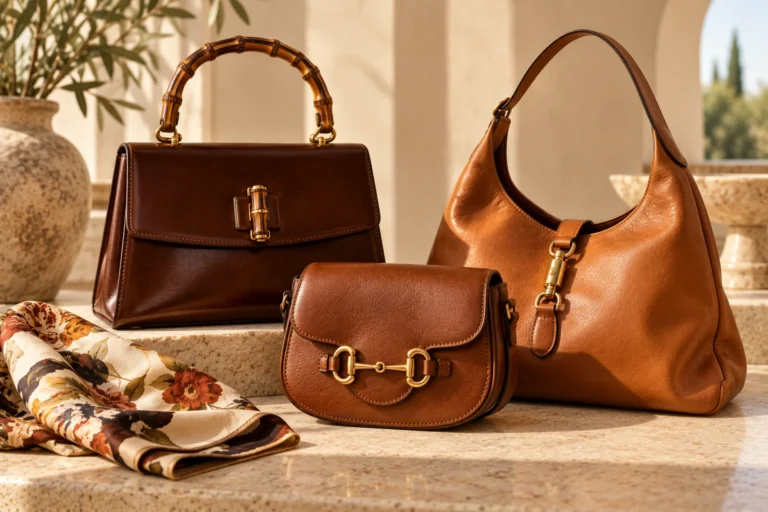
Few fashion houses have produced as many recognizable bags as Gucci. A curved bamboo handle, a horsebit clasp, a green and red stripe: each is enough to identify the brand without a logo in sight. The history of Gucci handbags runs for more than a century, and most of its best-known designs began as practical answers to a problem. Here is how a small Florentine luggage shop came to shape what a luxury handbag looks like.
Guccio Gucci opened his first shop in Florence in 1921. As a young man he had worked at the Savoy Hotel in London, where he saw the luggage that wealthy travelers carried and the standard of craft they expected. Back in Tuscany, he combined that taste with local leatherworking skill, selling luggage, travel goods and equestrian accessories. Horse riding was the sport of his clientele, and its hardware would stay with the brand for good.
In the mid-1930s, trade sanctions against Italy made leather scarce. Gucci turned to woven hemp and linen and developed a canvas printed with a small diamond pattern, trimmed in leather. The material was a workaround, but it became a signature, and the later GG monogram canvas descends from it.
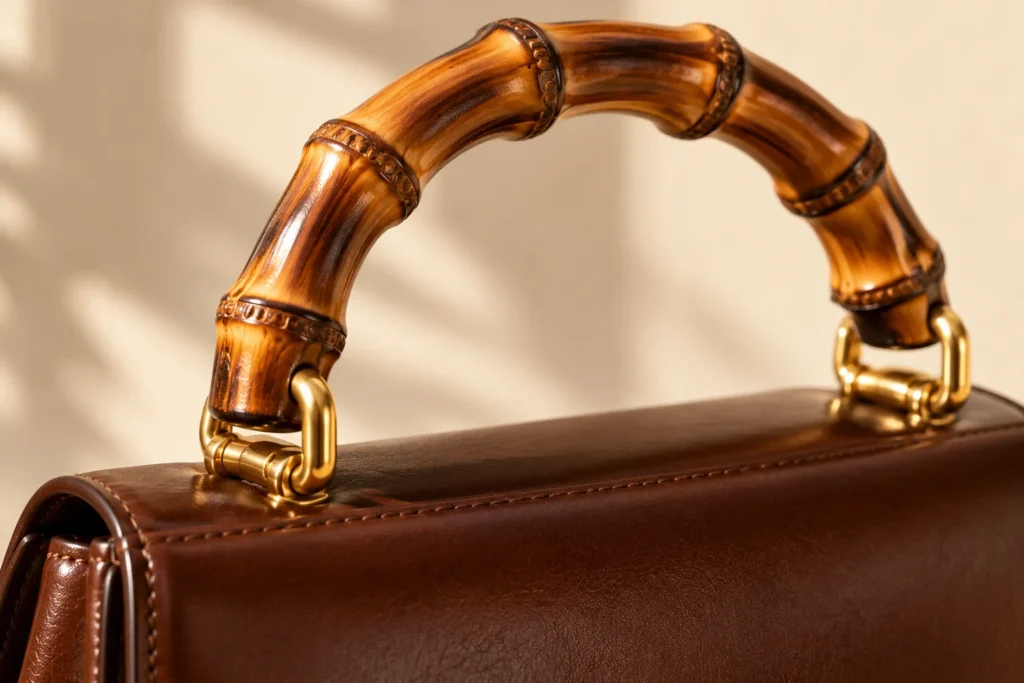
After the Second World War, materials were still hard to find. Gucci’s artisans began making handles from bamboo cane, which was light, strong and available. Each handle was heated over a flame and bent by hand into a curve, then lacquered. The Bamboo bag, introduced in 1947, was unlike anything else on the market, and it was soon seen on the arms of film stars. The technique is still used today, which means no two handles are exactly alike.
Two more house codes arrived in the 1950s, both from the stable. The green, red and green Web stripe was taken from the canvas girth strap that holds a saddle in place. The horsebit, a double ring joined by a bar, appeared first on loafers in 1953 and on handbags a couple of years later. Guccio Gucci died in 1953, and his sons, led by Aldo, took the business abroad, opening in New York that same year.
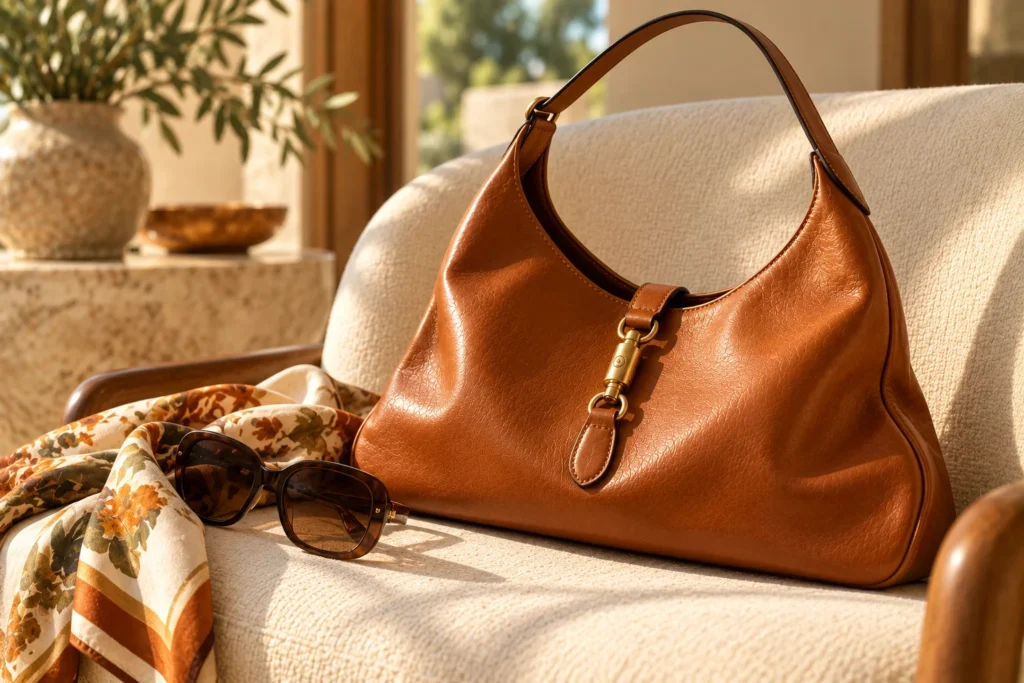
In 1961 Gucci released a soft, curved shoulder bag with a piston-shaped clasp. Jacqueline Kennedy was photographed carrying it again and again, often using it to shield herself from cameras, and the house eventually renamed it in her honor. The Jackie is one of the clearest examples of a bag made famous by the way a single person wore it. The interlocking GG logo, based on the founder’s initials, also came into wide use during the 1960s.
By the 1980s, family disputes and heavy licensing had weakened the brand. Its recovery began when Tom Ford became creative director in 1994. He replaced the tired image with sleek, confident collections and updated archive pieces, including a sharper Jackie and bamboo-handled styles. Gucci became one of the most wanted names in fashion again, and at the end of the decade it joined the group now known as Kering.
Frida Giannini, who had led accessories before becoming creative director, leaned heavily on the house’s history. She brought back the Flora print, first drawn as a scarf in the 1960s, relaunched the Jackie as the New Jackie in 2009 and reworked the 1947 original as the New Bamboo in 2010.
Alessandro Michele’s appointment in 2015 changed the mood entirely. His Gucci was romantic, eccentric and richly decorated, and it produced a run of bags that defined the second half of the decade:
Sabato De Sarno followed in 2023 with a quieter, more minimal direction, and in 2025 the house named Demna as its artistic director. Whatever the style of the moment, each new chapter returns to the same few ideas: bamboo, the horsebit, the Web stripe and the GG.
The designs that survive share three qualities. They are functional shapes first, they carry a detail that is instantly identifiable, and they are open to reinterpretation. The Jackie has been large and slouchy, small and structured, and it is still the Jackie. That is also why vintage Gucci holds interest on the resale market, and why checking authenticity matters. Our guide on how to tell if a leather bag is real covers the basics.
Gucci bags mix materials, and each needs different care.
For worn corners, cracked edge paint or a loose handle, see our guide to professional leather repair.
Read how the other great houses built their icons: Chanel, Hermès, Louis Vuitton and Dior.