
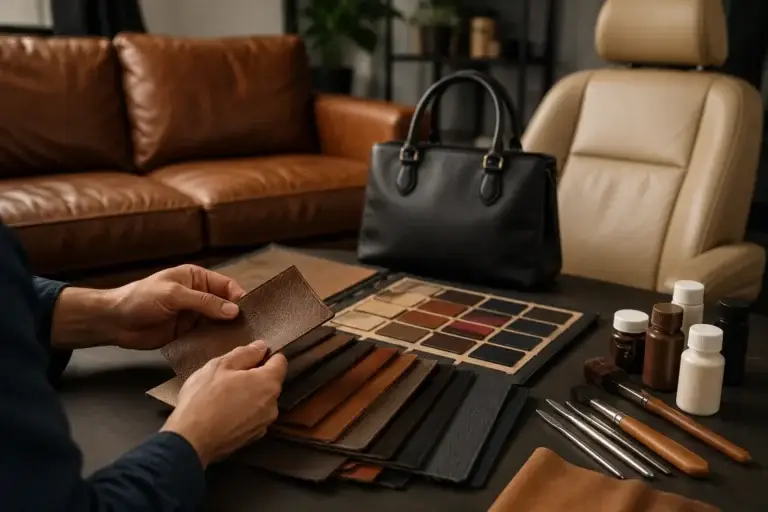
There’s a particular kind of regret that comes from handing a beloved leather piece to the wrong person.
The sofa your kids grew up on. The car interior you’ve kept pristine for a decade. The bag you saved up for and carried everywhere. You trust a repair shop with it, and two weeks later, it comes back with a color patch that looks nothing like the original, or stitching that starts unraveling before the month is out. The damage is still there — just different damage, now with a bill attached.
Sacramento has a growing number of leather repair providers. That’s mostly good news. But growth in supply doesn’t automatically mean growth in quality, and knowing how to tell the difference before you hand something over is the skill worth developing. This guide gives you that.
Most people shop for leather repair the same way they shop for a plumber — they call a few places, compare quotes, and go with the lowest number that doesn’t make them nervous. That approach works reasonably well for plumbing. It fails consistently for leather.
The reason is that leather repair is a craft with a wide skill ceiling. The gap between a mediocre result and a genuinely invisible repair is enormous, and it comes almost entirely from the technician’s skill and material knowledge — not from how much they charge. In fact, experienced leather specialists often charge less than you’d expect, while less skilled operators sometimes charge premium prices for inferior work.
The smarter starting question isn’t “how much?” It’s “have you done this exact type of repair before, and can you show me?”
Here is something the industry doesn’t advertise loudly: the leather in your living room, your car, your boat, and your doctor’s office are not the same material treated the same way. They differ in tanning method, coating type, thickness, backing, and how they respond to heat, humidity, UV, and cleaning agents. A repair technique that works brilliantly on one type can ruin another.
This is why the best leather repair shops tend to specialize — and why you should match the shop to the job.
This is the most common residential need, and the most common category of shop. What separates good providers here isn’t just technique — it’s the ability to do seamless color matching on aged leather. New dye on a ten-year-old sofa has to account for how that leather has changed over time: faded patches, oils absorbed from years of use, and areas that have dried and lightened near armrests. A quality technician mixes color on-site, tests it on a hidden area, and adjusts before committing to the full repair. Anyone working from pre-mixed bottles without a test patch is guessing.
Vehicle leather lives a harder life than anything in your home. It flexes with every entry and exit, bakes in Sacramento’s triple-digit summer heat, and gets abraded by jeans, belts, and seatbelts thousands of times a year. The bolster — the outer edge of the seat where most wear happens — is a diagnostic tell for any auto leather technician: if they can restore a badly worn bolster without visible lines or texture difference, they know what they’re doing. Ask to see bolster repairs specifically.
Recreational vehicles carry a particular set of material challenges. Manufacturers often use vinyl-leather blends rather than full leather to save weight, and the combination of road vibration, temperature swings between travel and storage, and tight interior geometry makes repairs more technically demanding than standard residential work. A technician who has never worked on an RV interior will spend time learning at your expense. One who has done it regularly will spot the issues immediately and quote accordingly.
Marine environments are hostile to leather in ways that have no inland equivalent. Salt air accelerates oxidation. UV on open water is more intense than on land. Condensation and humidity create mildew conditions that destroy standard repair compounds from the inside. Any shop taking on marine leather work needs to be using UV-stable pigments, mildew-resistant sealers, and flexible compounds that won’t crack when the leather moves with temperature change on the water. Ask exactly which products they use and whether those products are rated for marine applications. If they can’t answer that specifically, keep looking.
Restaurants, hotels, and office lobbies run on different economics than private homes — downtime has a dollar value, and volume matters. A good commercial leather repair provider understands this and structures their service accordingly: on-site work during off-hours, the ability to handle multiple pieces in a single visit, and invoicing that works for business accounts. If you’re managing a property or a hospitality business in Sacramento, ask whether the shop has commercial clients and what their typical turnaround looks like on multi-piece jobs.
Treatment tables, clinical recliners, and procedure chairs operate in a category governed by regulations that most leather technicians have never had to think about. The materials used in a medical setting must withstand repeated cleaning with hospital-grade disinfectants — bleach solutions, quaternary ammonium compounds, and other agents that would destroy standard leather finishes in weeks. Ask directly whether the shop has worked in clinical environments, and ask which sealers and topcoats they apply. This is not a category to treat casually.
Aviation interiors exist in their own regulatory universe. The FAA has specific requirements for materials used inside aircraft cabins — fire resistance ratings, off-gassing standards, and documentation requirements that most leather repair shops are simply not equipped to meet. If you own or manage a private aircraft, this is the one category where credentials must come before portfolio. Ask for documented experience with aviation interiors, ask which FAA-compliant materials they use, and expect to provide the aircraft’s registration information as part of the service process. A shop that doesn’t ask for any of that hasn’t done this work before.
Luxury goods repair is a different discipline from furniture or automotive work — closer in spirit to fine jewelry restoration than to upholstery. The stitching on a high-end bag follows specific patterns that identify the brand as much as the hardware does. The leather types — calfskin, lambskin, Saffiano, caviar — each respond differently to cleaning agents and conditioning products. Color restoration on a bag that retails for several thousand dollars demands a level of precision that not every leather technician has. Look for shops that specifically list luxury handbag work, ask to see before-and-after photos of similar bags, and never leave a valuable piece without a written receipt describing its condition.
This one gets misclassified constantly. Customers see a saggy, deflated sofa and assume it’s a leather problem — worn-out upholstery that needs patching or refinishing. Often, the leather is fine. The problem is underneath it: failed spring webbing, compressed foam that has lost its memory, or broken support rails. A quality shop diagnoses the real issue first. If a technician quotes you only for a surface leather treatment without examining the support structure, they either haven’t looked carefully or don’t work at that level of depth. The right fix addresses what’s actually causing the sag — which may mean re-springing, re-foaming, or reinforcing the frame — before any leather work is considered.
Once you’ve identified shops that specialize in your type of repair, evaluate each one against these criteria.
A real portfolio, in daylight. Before-and-after photos taken in natural light, without filters, showing work on pieces similar to yours. Color matching is much easier to fake under artificial lighting or heavy editing.
On-site color mixing. This is the single most reliable indicator of skill. Pre-mixed color from a bottle is a shortcut that almost always shows. A custom-mixed pigment matched specifically to your aged leather is what produces repairs that disappear.
A written estimate before work begins. Every credible shop provides this without being asked. It protects you both. Any resistance to putting scope and cost in writing is worth noting.
A workmanship warranty. Six months to a year is standard among quality providers. It doesn’t cover normal wear, but it does cover the repair itself — if the color peels, the patch lifts, or the stitching fails, it gets fixed at no additional cost.
References for your specific type of job. A glowing reputation for sofa repairs doesn’t automatically translate to capability with marine upholstery or aviation interiors. Ask for references from customers with similar needs.
That last question is diagnostic on its own. A technician who promises a completely invisible result on significant damage is either inexperienced or overselling. Someone who says “on a repair this size, under good lighting, you’ll see a slight texture variation but the color will be seamless” is telling you they’ve actually done this work and know what the honest outcome looks like.
This is local knowledge that matters. Sacramento’s summers are aggressive — sustained heat above 100°F combined with intense UV exposure dries leather faster than almost any other climate in California. Leather in a parked car can reach internal temperatures that cause irreversible surface cracking within a season if it isn’t conditioned and protected regularly.
Any Sacramento leather repair technician worth their trade will factor this into their recommendations. After any repair, they should be applying a UV-protective topcoat and recommending a conditioning schedule appropriate to your local conditions. If climate doesn’t come up at all in the conversation, it suggests either a lack of local experience or a lack of thoroughness.
One more thing worth raising with any shop you’re seriously considering: at what point is replacement the better choice?
This isn’t a trick question — it’s a genuinely useful one. An ethical leather repair technician will tell you honestly when a piece is beyond economic repair, when the damage is too extensive for the result to be satisfying, or when the material quality is too poor to hold a repair reliably. A shop that will take any job regardless of whether the outcome will be good is not looking out for you.
The willingness to occasionally turn work away — or to redirect you toward a more honest solution — is one of the clearest signals of a shop that operates with integrity.
Quality leather repair in Sacramento comes down to three things: the right specialization for your specific job, the technical depth to do it properly, and the honesty to tell you what’s realistic before you commit. Price matters, but it should be the last variable you evaluate, not the first.
Ask to see the work. Ask the specific questions. Read the warranty. And trust your instincts — a technician who is confident in their craft doesn’t need to be vague about their methods, reluctant about their portfolio, or evasive about their experience.
The right shop exists in Sacramento. It just takes a few more minutes to find them than clicking the first result and calling it done.

Your go-to destination for all things handbags and purses — from the latest trends and care tips to leather restoration guides and expert handbag repair shop directories.
Don’t miss our future updates! Get Subscribed Today!
©2025. LeatherBagss.com. All Rights Reserved.